
The Digital Repeater Network
Digital modes offer many new opportunities to Hams
| Sponsor | Call | Gateway | Frequency | Offset | Elevation | Location |
|---|---|---|---|---|---|---|
| Upper Rio FM Society | W5URD B | W5URD G | 444.525 Mhz | +5 Mhz | 9,380 | Capilla Peak |
| Upper Rio FM Society | K5URR B | K5URR G | 449.450 Mhz | -5 Mhz | 5,400 | Upper Rio Hub |
| Upper Rio FM Society | K5URR C | K5URR G | 146.860 Mhz | -0.60 Mhz | 5,400 | Upper Rio Hub |
| LADRA** | NM5WR B | NM5WR G | 442.425 Mhz | +5 Mhz | 6,462 | White Rock |
| Santa Fe ARES | W5SF B | W5SF G | 449.450 Mhz | -5 Mhz | 7,372 | Santa Fe |
| Socorro ARC | W5AQA B | W5AQA G | 444.500 Mhz | +5 Mhz | 7,236 | Socorro "M" Mountain |
| Mesilla Valley ARC | N5GB C | N5GB G | 146.840 Mhz | -0.60 Mhz | 4,932 | Tortugas "A" Mountain |
| Cheyenne Mountain Repeater Group | KD0RDI B | KD0RDI G | 446.775 Mhz | -5 Mhz | 8,515 | Raton Pass |
| SNLARC* | W5MPZ B | W5MPZ G | W5MPZ G | +5 Mhz | 10,660 | Sandia Crest |
* Sandia National Lab ARC
** Los Alamos D-Star Repeater Association
- Use this link to register or check your registration status: https://regist.dstargateway.org/Dstar.do
- Use the links in the side bar to check the status of the Upper Rio D-Star repeaters
- Here is a list of all D-Star repeaters: https://www.dstarusers.org/repeaters.php?repeatersort=5 Use the up/down arrows next to state to sort and view New Mexico repeaters
Archive information below this line
Update: September 13, 2012
A new D-Star reflector for New Mexico has been brought on-line by the Upper Rio FM Society. This is reflector REF055
The server for this reflector and the internet connection are being provided by Lobo Net. The internet connection is high bandwidth capable of 100 Mbits/sec symmetric. This should permit a large number of D-Star Gateways to connect simultaneously.
A D-Star reflector has 4 modules (A, B, C, & D) that a gateway can link to.
- The “A” module of reflector 55 has been designated for uses by gateways in New Mexico and surrounding states.
- The “B” module has been designated for use by New Mexico ARES/RACES, Search & Rescue and SKY Warn.
- The “C” and “D” modules have been designated for open use by any D-Star user in the world.
The Upper Rio Gateways (W5URD and K5URR) have been configured to automatically link to REF055A daily from 06:00 – 21:30 local time. Of course any user can unlink a gateway from the reflector to initiate a link to somewhere else.
Other New Mexico Gateway administrators have been invited to link in there gateways also. As of this writing, the Los Alamos (NM5WR) gateway is also linking in regularly.
The status of the reflector can be viewed at http://ref055.dstargateway.org/
Update: August 16, 2012
The new K5URR D-Star UHF D-Star repeater/gateway is operational.
Some details of the Repeater and Gateway:
- The repeater is an Icom ID-RP4000V
- The repeater operates on 449.450 Mhz (with a -5Mhz offset)
- The controller is an Icom ID-RP2C
- A set of cavity filters are used for receiver/transmitter isolation
- A preamplifier has been added to the receiver to insure that K5URR has good ears
- A 2.8 Ghz dual-core Intel Pentium processor
- 2 Gbytes of high-performance RAM
- 2 Intel Pro Series Network Interface Cards
- 2 40 Gbyte solid state hard drives*
- An Asus P5G41-M Motherboard
- This system is connected to the internet through a commercial-grade Cisco 2621 router (very reliable)
Should the “C” drive fail we will be able to remotely power-cycle the computer which will force a reboot. When the system fails to boot from “C” it will switch to “D” and keep going.The system is being configure so that in the unlikely event of a loss of power, the system will automatically reboot when power is restored. The system will also include a Uninterruptable Power Supply for the computer and router. The repeater and controller operate on 12 Volts and will be connected to the Hubs site battery bank.Any ham can use the K5URR machine as a stand-alone repeater, but to access the full capabilities of D-Star, you will need to be registered. Registration is a simple matter of opening a web page, entering your name, call-sign, email address and a password.Once your registration is approved (a quick process required to insure that only licensed hams have access to the D-Star repeater network) you will be able to edit your personal information to define your “terminal”. There is an excellent web page that describes the entire registration process at:
To register on K5URR go to:
http://k5urr.dstargateway.org/
If you have an interest in D-STAR I encourage you to register. You don’t have to own a D-Star capable radio yet!
Update: December 7, 2011
False alarm. The W5URD repeater issue appeared to be a battery charger problem. The charger has been repaired and the W5URD repeater is now back on the air.
Update: November 27, 2011
The W5URD D-Star repeater has experienced a hardware failure. The failure appears to be in the RF output section (the repeater appears to be able to still receive). The Upper Rio technical committee has contacted ICOM and is working out details to have the repeater repaired. Check back here for more details as they become available.
Update: October 1, 2011
The W5MPZ D-Star repeater has been moved to Sandia Crest and is operational as a stand alone repeater until work to install the internet connection is complete. Frequencies remain the same (443.8MHz, +5.0MHz offset).
Another D-Star repeater is being installed in the Las Cruces area. Once operational it will be on top of “A-mountain (Tortugas Mountain) and operated by the NMSU radio club – W5GB.
Update: August 4, 2011
The D-Star repeater has been installed on Capilla Peak and is operational! See below for more details.
- Call Sign: W5URD B (Module B is the UHF module)
- Gateway: W5URD G
- Frequency: 444.525MHz, +5.0MHz offset
A second D-STAR repeater is also operational in Albuquerque. Even though the repeater has not been installed in its perminant location (Sandia Peak) it is operational and available for use. It is operated by the Sandia National Laboratory ARC.
- Call Sign: W5MPZ B
- Gateway: W5MPZ G
- Frequency: 443.8MHz, +5.0MHz offset
There is also a D-Star Yahoo Group (e-mail reflector) for D-Star activity in New Mexico. If you are interested in joining visit http://groups.yahoo.com/group/nm-dstar/
The Capilla Shack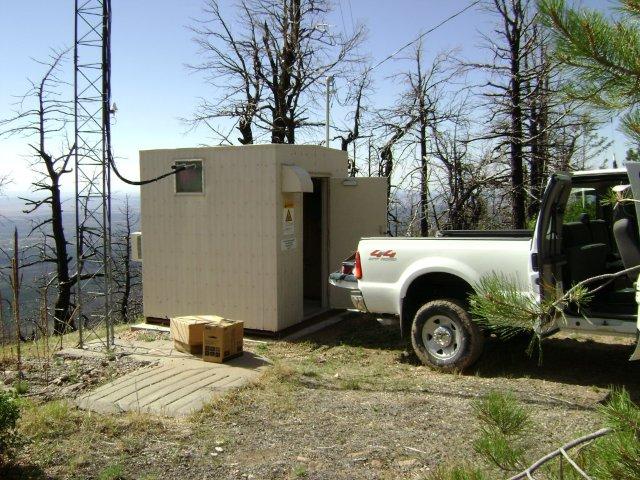 |
The Capilla Antenna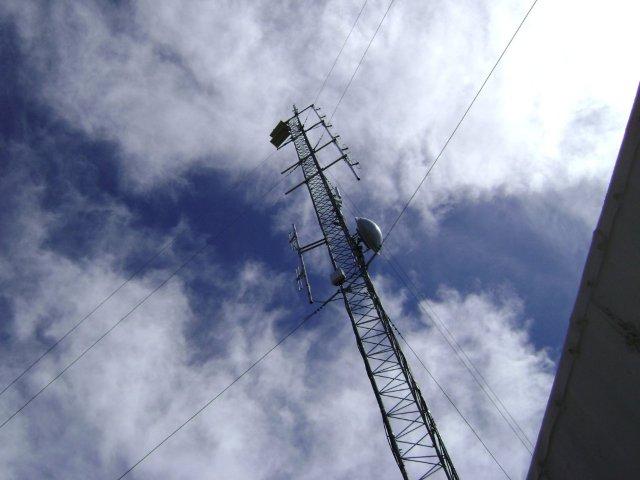 |
Update: July 27, 2011
The repeater’s Internet router is out being reconfigured. This will take a couple of days to complete. The repeater will continue to operate locally without the router but remote connections and registration of new users will not be possible until the router is returned and reinstalled.
Update: July 16, 2011
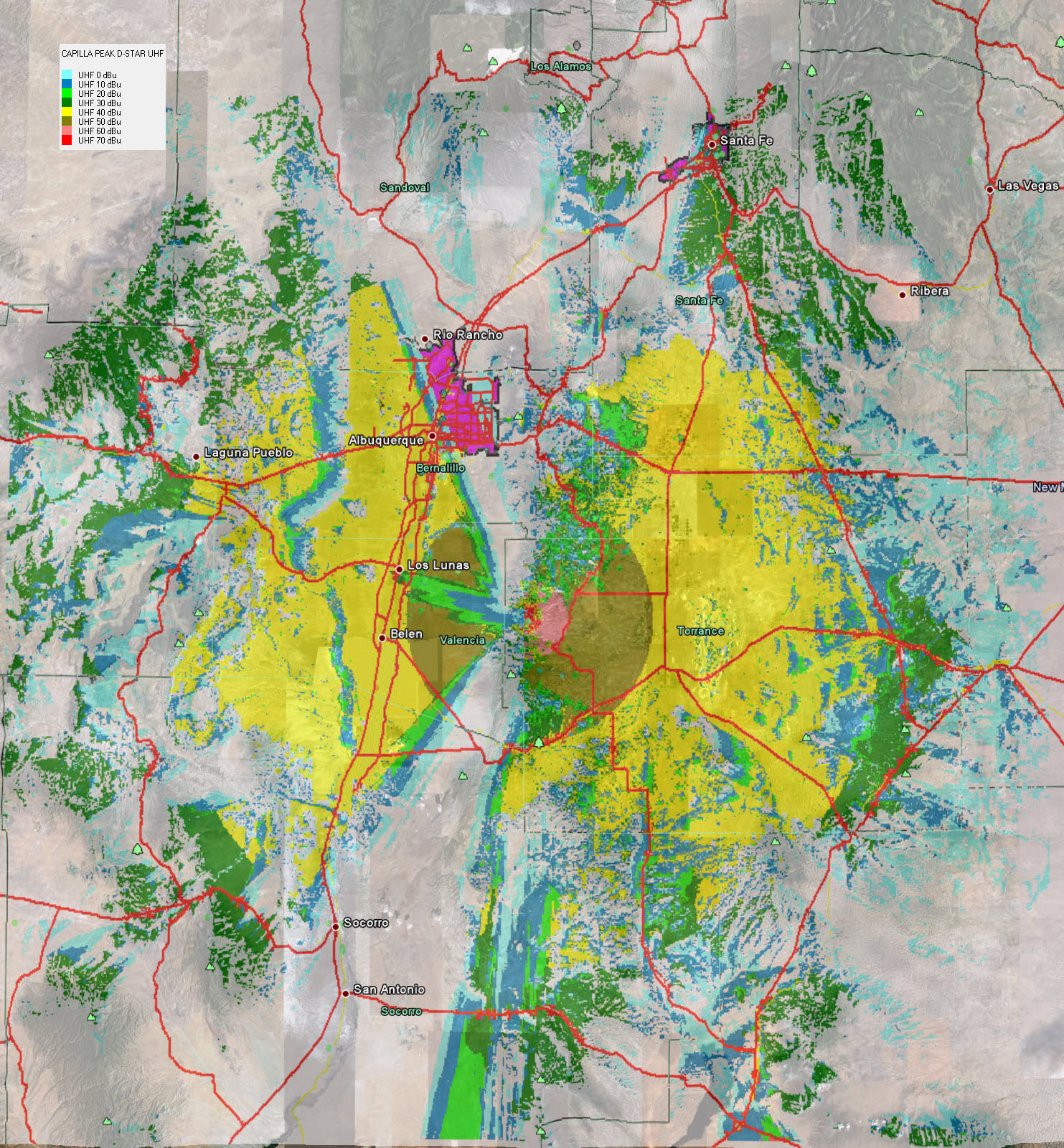 |
Predicted coverage for W5URD. A Google earth file will be available soon. Calculations courtesy of Mike Eaton, K5MJE
The Upper Rio FM Society is in the early stages of bringing a D-Star repeater online. The repeater will use the call sign W5URD (W5 Upper Rio Digital) and will be installed on Capilla Peak where it will have broad coverage. See the predicted coverage map to the left that Mike Eaton, K5MJE, produced.For the next several weeks the repeater will be located in Paul Choc’s, WA5IHL, shop (near Central and Eubank) while it undergoes final configuration and testing. Please feel free to use the repeater at this time — with the understanding that coverage will be limited for a few weeks.The repeater is operating on 444.525 Mhz (with a +5Mhz offset).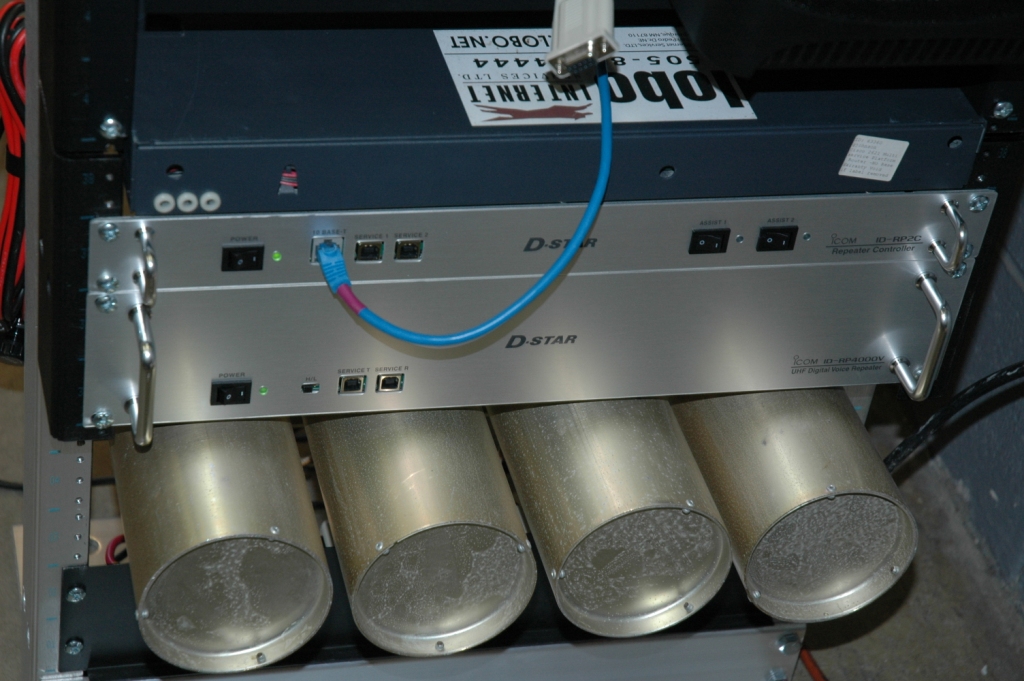
(click image for a better view)
The short story – D-Star is digital HAM radio. Don’t confuse D-STAR with technologies like IRLP and EchoLink. IRLP and EchoLink use standard analog modulation to transmit RF messages and Internet technologies to provide linking between stations. D-Star is simply a digital modulation technology. D-Star radios communicate point to point over RF by sending a digitized voice. D-Star can also utilize Internet technology to provide remote node linking but this is not necessary.
Any HAM can use the W5URD machine as a stand-alone repeater, but to access the full capabilities of D-Star, you will need to be registered. Registration is a simple matter of opening a web page, entering your name, call-sign, email address and a password.
Once your registration is approved (a quick process required to ensure that only licensed hams have access to the D-Star repeater network) you will be able to edit your personal information to define your “terminal”. There is an excellent web page that describes the entire registration process at: http://www.dstargateway.org/D-Star_Registration.html
- To register on W5URD go to: https://w5urd.dstargateway.org/Dstar.do
- To see who is currently using the repeater and where its linked to go to: https://w5urd.dstargateway.org/
- If you have an interest in D-STAR we encourage you to register. You don’t have to own a D-Star capable radio yet!
The long story – It would be foolish to try and reproduce on this page the wealth of information about D-Star that is available on the Internet. A good place to start is Wikipedia. Then Google “D-STAR”.
|
The Upper Rio D-STAR repeater description
The computer that runs the D-Star gateway software was custom built for the job including:
|
The complete repeater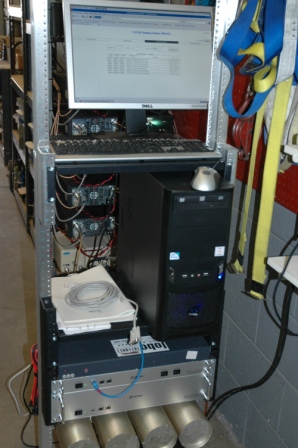 |
*solid state drive were chosen both for reliability in the mountain-top environment and for performance (they are really fast!). They are being configure so that the “C” drive is automatically cloned to the “D” drive. Should the “C” drive fail we will be able to remotely power-cycle the computer which will force a reboot. When the system fails to boot from “C” it will switch to “D” and keep going.
The system is being configure so that in the unlikely event of a loss of power, the system will automatically reboot when power is restored. The system will also include a Uninterruptible Power Supply for the computer and router.
The planed repeater site is remote and difficult to access in winter (snow) and summer (fire danger). To improve reliability, an intelligent power distribution system will also be installed. The system will support an autonomous reboot capability (partial or complete power cycle) if a system hang is detected locally and a backup remote initiated reboot if a problem is not detected locally.
The repeater and controller operate on 12 Volts and will be connected to the Capilla site battery bank.